
You want to unplug, completely. You want to spend time in a place that feels like another planet, in the middle of nowhere, surrounded by empty space. You want to see fascinating alien creatures, but not the kind that can eat you (at least, not without taking many, many tiny bites). You don’t like mosquitoes. You enjoy feeling like you’re cooking slowly in a dry oven during the day—a convection oven, with a breeze. You like cozying up in the chill of the night under the starriest sky you’ll ever see.
In other words, Mars sounds pretty neat.

Oh, except you also like hot showers, and flush toilets, and refrigerators.
I guess Mars isn’t the place for you after all, though it sounds pretty close to that first paragraph. For one thing, we can’t get there just yet, and once our species sorts out the travel issues we’ll have to wait at least a generation or two for the billionaires to finish partitioning it out amongst themselves and mining as many natural resources as are still relevant. Once that winds down and tourism becomes more lucrative than mining, it might be an option, but that’s not going to help you now; plus it’ll take a little while to get the plumbing sorted out.
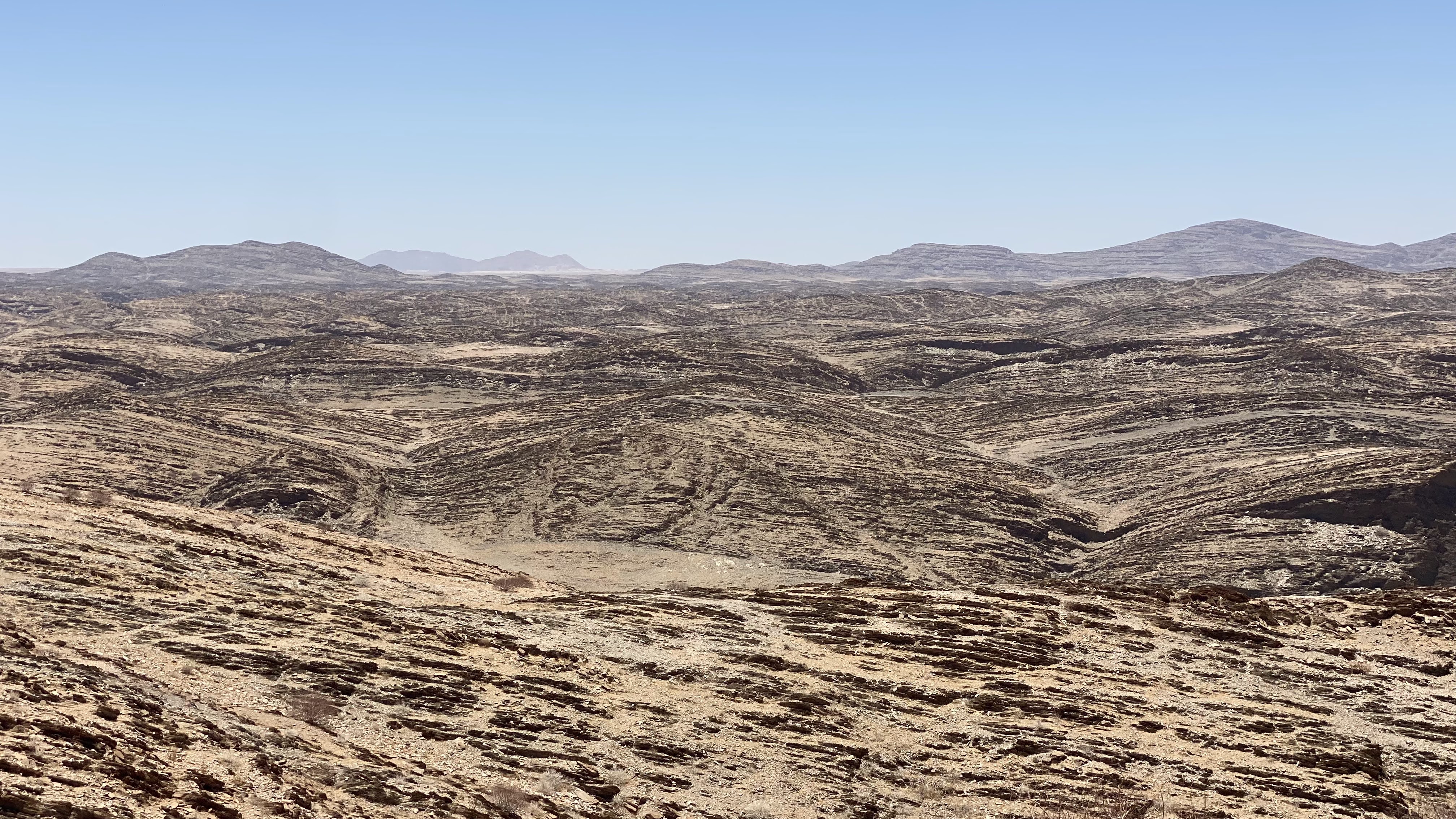
Lucky for you, all the things you’re after exist right here on earth, no space passport required.
You, my friend, need to get yourself to Namibia, stat.

There are, however, a few things you should know before you hop on that plane: how NOT to get stranded in the desert, for one. And perhaps a few tips on amazing campsites, and a shopping list, and a note on exactly what camping setup you might like to rent. Having just returned from my second trip to the country, I’m happy to help. Read on!
Disclaimer: I am emphatically not a “camper”. In fact, I’ve been on exactly two camping trips, both to Namibia, so I’m no expert. I’m a person who enjoys adventure, does a lot of research in advance, and takes notes and pictures along the way. Some of the advice here might be flawed or out of date, so you should do your own proper research, beyond this post. Cool? Cool. Let’s hit the road!
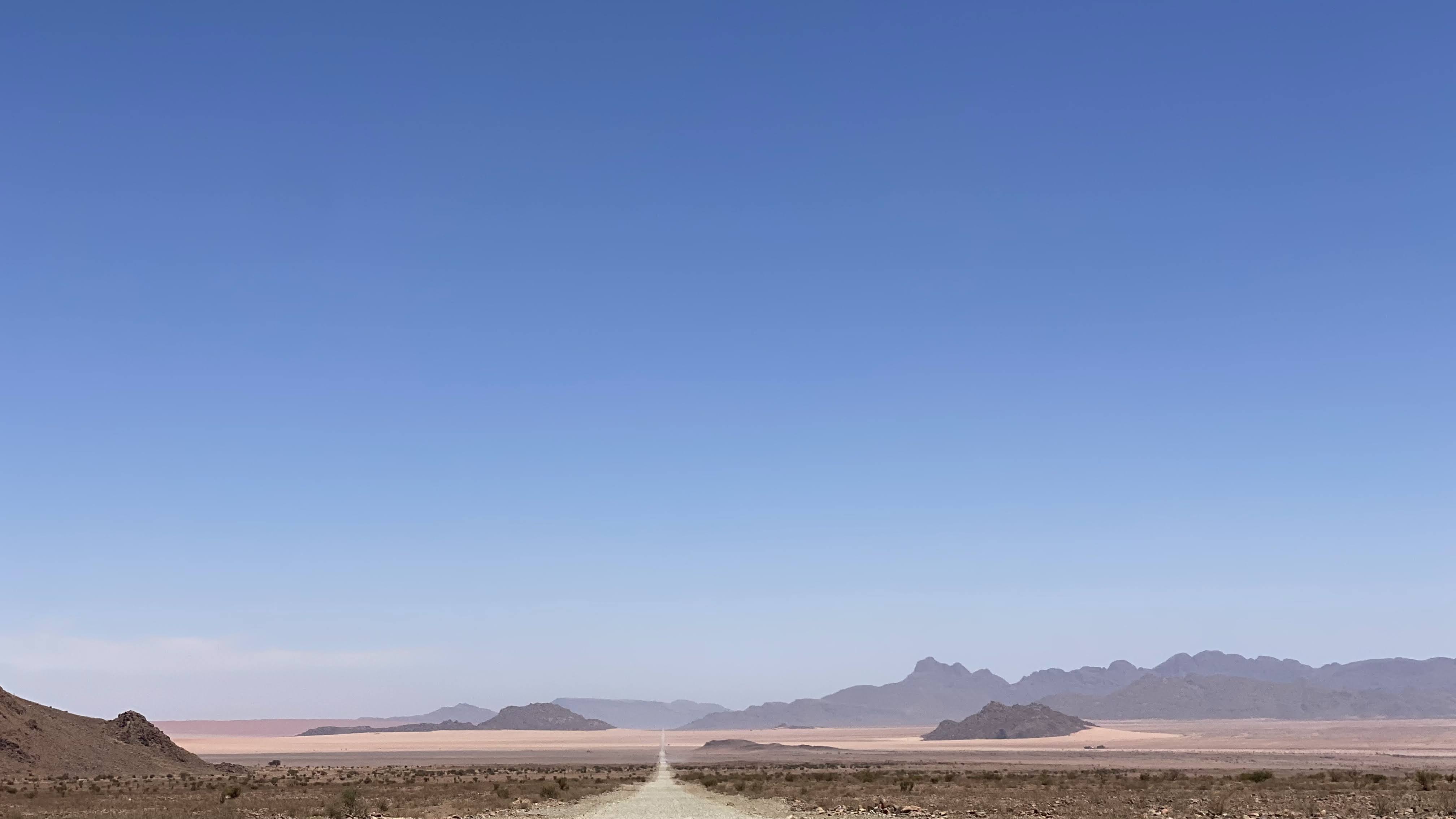
Getting there
First things first: depending on where you’re from and how you’re entering the country, there’s a good chance you’ll need an entry visa. It’s pretty quick and painless but you do have to handle it ahead of time and print out the paper. Be sure to read the latest requirements from the official government website as it has recently changed and surely will again.
Ok, paperwork sorted. Now how do you get to Namibia? On our first trip, we drove there from Cape Town. Totally possible—the car rental company I recommend below will even deliver your vehicle to you for a one-way rental—but you’ll need a lot of time and fortitude if you take this route. We’ll get to the time bit later, when we talk about the roads. For now, especially if you’re planning a trip that’s any less than 2 weeks, you should plan to fly in (and out) of the capital, Windhoek.
Despite being home to the majority of the people in the country, Windhoek is small, and the airport is smaller. That means the planes that can land there are also pretty small, so you’ll almost certainly have a transfer along the way, probably in Johannesburg or Cape Town. Give yourself plenty of transfer time; you will have to exit the terminal completely (including passport control), then re-enter (including security checks and passport control, again) to board your flight to Namibia. Airside transfers have not caught on yet in South Africa (your bags might get checked through, but be sure to confirm this with your airline).
Speaking of checked bags: if you fly through Joburg, there’s a very good chance your luggage won’t make it onto your second flight, but will rather come along later, after you talk to the nice people at the lost luggage counter and file a report. If that happens, get their phone number and make arrangements to come back to the airport and fetch your luggage when it arrives, hopefully on the next flight (they’ll offer to send it to you, but apparently this is unreliable and takes much longer). We learned from the locals that luggage gets stuck in Joburg all the time, though it’s not consistent; one of our two bags made it onto our flight but the second did not.
Windhoek airport has about six “gates”, but each flight uses two (one for first class, one for economy), and let’s be clear that “gate” in this case means “door” and the door leads out to the runway slash plane parking lot. Consider having your sunscreen at the ready; it’s a bit of a hike between the terminal and the plane, sometimes you have to wait in line, and that sun is hot.

Anyway. You’ll walk off the plane into the terminal, have your visa glanced at and your passport stamped, grab your bag (hopefully), and look for your driver.
What driver, you ask? The one from the car rental company that’ll pick you up at the terminal and drive you to the rental lot. The airport is about 45 minutes from the city, so you’ll definitely want to arrange a pickup (unless you rent from one of the car companies with an airport location I suppose, but my recommendation is for a company in town).
Before you leave the airport: stop and get a SIM card from the shop right by the exit door, and draw some cash from one of the ATMs next to that shop (most places will take cards but you’ll want cash as a backup and for tips). Normally I would recommend doing both of these things in town as it’s usually cheaper, but in Namibia you should do it at the airport. The cell shop in town is hard to navigate, while the one at the airport is used to dealing with tourists and the process is quick and easy. Data is cheap (and you won’t need a ton, there’s not much service in most of the places you’re going and the goal is to unplug, right?). You can get an E-SIM if your phone supports it, or a physical SIM if not. Of course your phone needs to be unlocked, but surely you’ve done that already? If not, what are you waiting for? Let’s break the cell monopolies, one phone at a time…
Ok, you’ve got your phone working, you’ve got a bit of cash, and your driver is probably getting a little impatient (p.s., tip your driver). It’s time to talk about the car!
Your vehicle
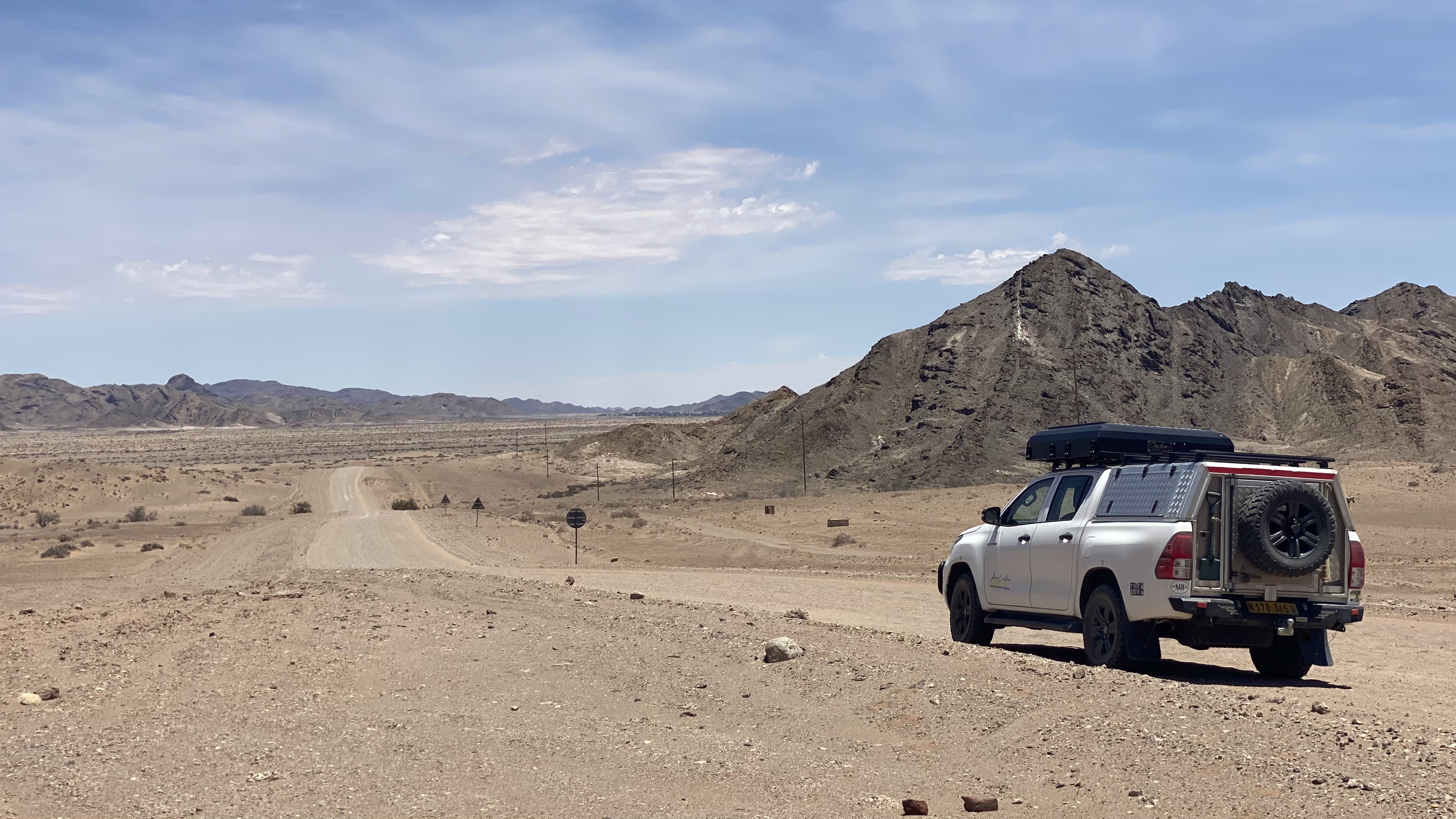
Shameless plug without any sort of kickback: Asco Car Hire in Windhoek is great. We’ve rented from them both times and they’re helpful, fair, reasonably priced, and their vehicles are well-maintained. I do have two very strong suggestions (for any car rental but especially here):
- Read the rules and follow them (particularly the speed rules, which aren’t standard).
- Buy all the insurance (and refer to 1, because breaking the rules voids the insurance).
One more thing: watch Asco’s video tutorials before you leave home. Their YouTube channel is a treasure trove: even if you don’t rent from them, the driving tips are really helpful! If you do rent from them, having an idea how to set up their equipment and where everything is located ahead of time will give you a lot of confidence, and save you from waving your phone around trying to find a signal to work out how to unlock the camping table from the hatch.
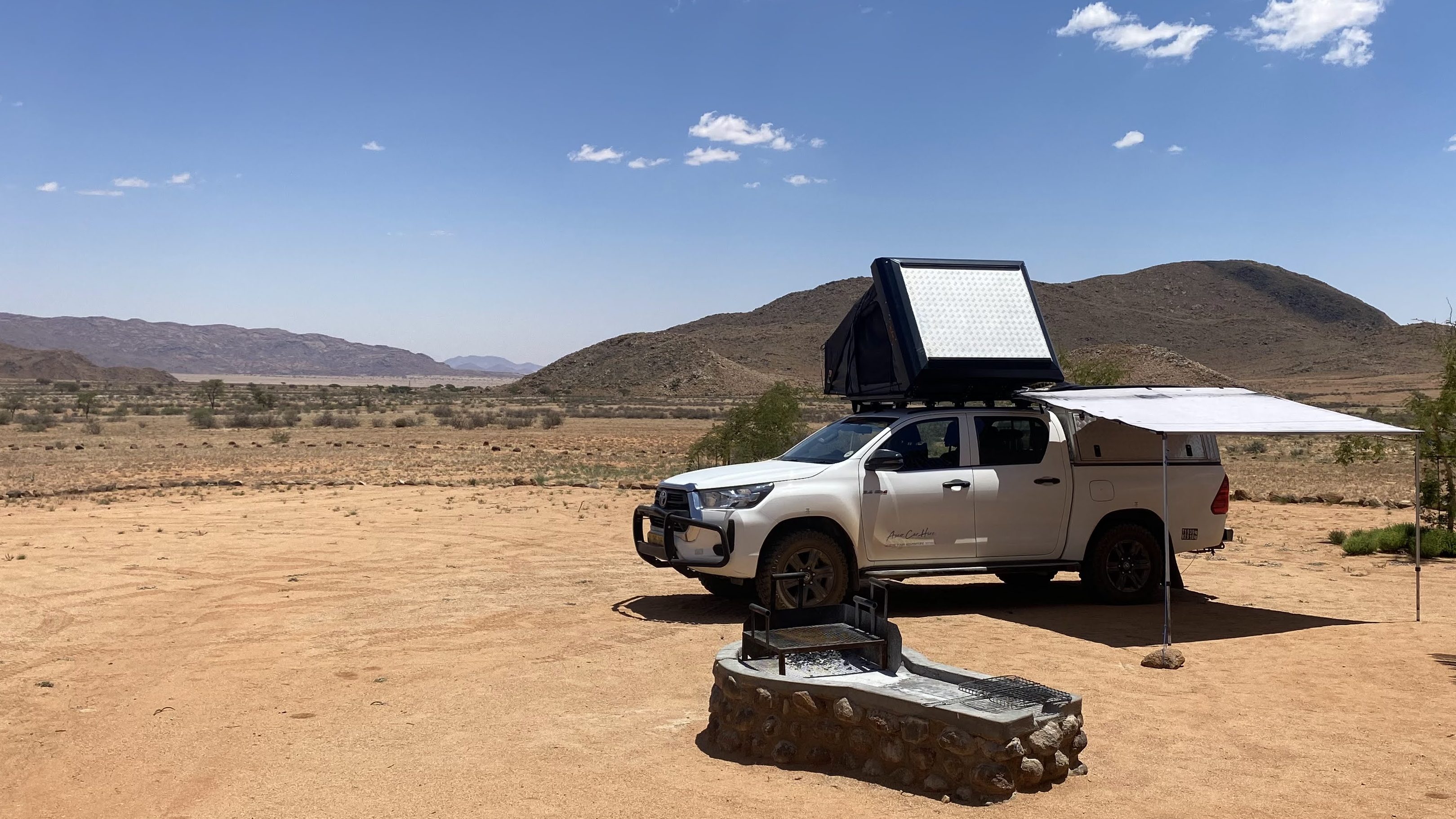
What should you rent? You’re an adult, you can do what you want, but I loved our rentals so I’m gonna be very specific. For both of our trips, we went with “GROUP VSS+ – Budget Toyota Hilux Safari 2.8 Double Cab Automatic with Camping” which is on the “Budget 4×4 with camping” page of the site. The Hilux is awesome and although I normally prefer a manual, having an automatic was pleasant for the very long drives. The budget version is just a couple years older than the premium option, and it was perfectly fine.
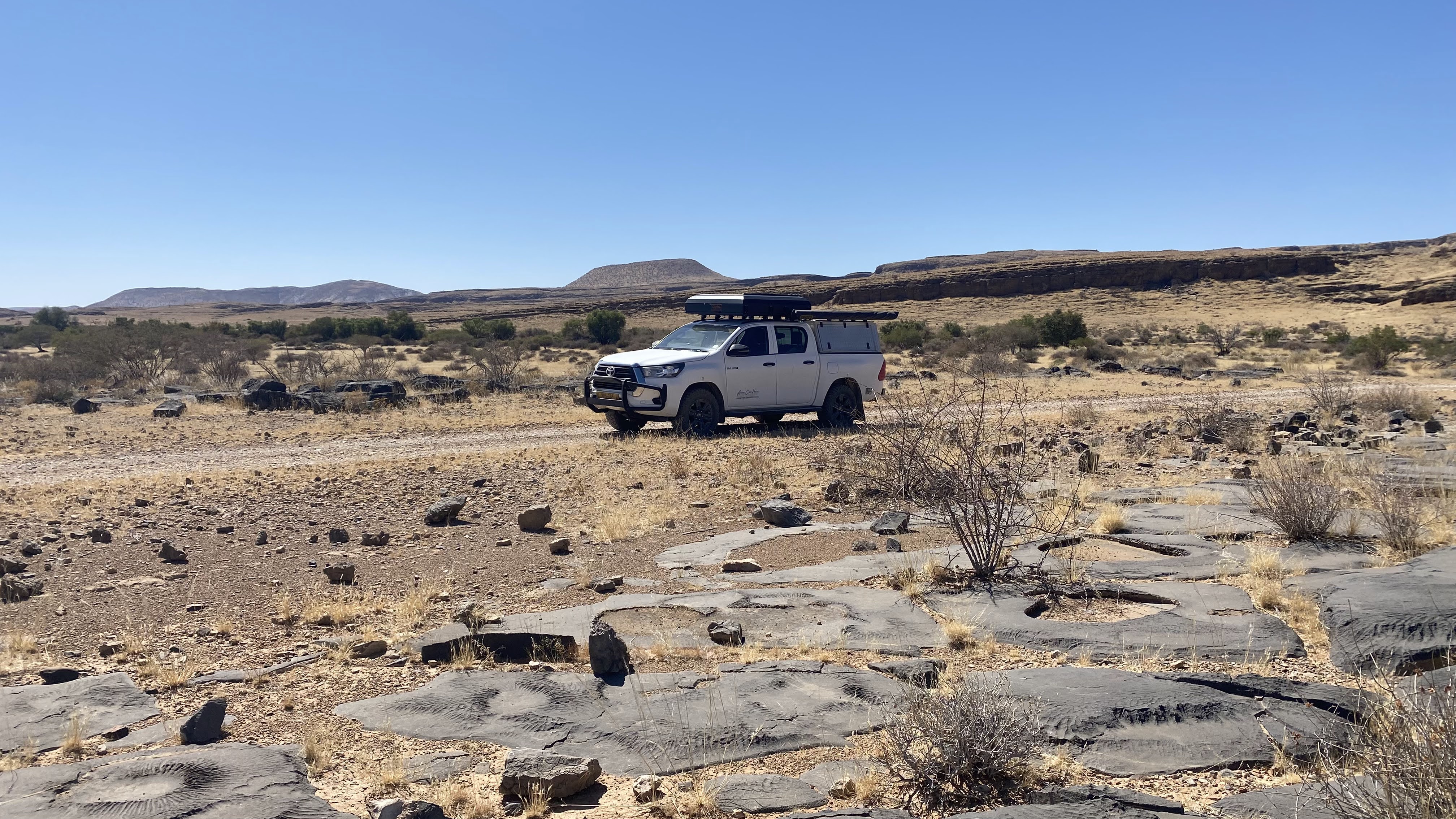
Next, you’ll want to go to the “Extras” page and add on the “Luxury camping set”. This is worth every penny and then some. The hardtop tent is fantastic (it’s got a mattress and duvet and pillows!) and the awning is great for keeping the sun off the fridge side of the cab and providing a bit of shade during the day.
Side note about the tent: it lives on top of the car and you get in and out via ladder. This is amazing for so many reasons, mostly having to do with bugs (or rather, lack of) and breezes. You’ll love it.

Pro tip: don’t even try with the tent stakes for the awning, the ground is far too hard. The wind tends to kick up without warning so you should be prepared, but just wrap the cords around a couple big rocks instead.
You don’t need any of the other extras: your rental comes with plenty of camping equipment, and your local SIM card (see above) negates the need for GPS. As noted above, though, get the Super Cover insurance. Trust me. If you make it out of Namibia without a few new chips in the windshield at the very least, you should go buy a lottery ticket immediately as you’re clearly experiencing unholy luck.
Ok, you’ve arranged all that in advance. When you arrive at the car rental location, you’ll do the usual paperwork, then you’ll get a walkthrough of the vehicle. Take the walkthrough and ask questions. Have them show you exactly how to set up the tent and unhook the spare tire and access the water faucet etc. Even if you watched the videos (which you did, right?) and even if you’re a seasoned camper, these tips will save you time and make everything that much easier when you get to your first campsite. It’s worthwhile!
Your first night
It’s tempting to head straight out on the road and get right to the camping, I know. However, you don’t want to wind up on a delayed flight, or with missing luggage, or take too long in the grocery store and find yourself late on the road, rushing to get to your camp before dark.
Instead, spend the first night in Windhoek, and head out early the next morning. There are plenty of Airbnbs in and near the capitol; check reviews and look for a comfy place with parking, and take your first day slow. You’ll be much happier taking care of all your errands and having a nice restaurant meal the first day, then getting a good night’s sleep in a real bed to deal with the jetlag before setting off early the next morning.
Driving
Driving in Namibia is not like driving at home (unless you live in Namibia, I suppose). Despite encountering hardly any other cars on the road, we saw two terrible car accidents in the space of a week. It’s no joke; do not become a statistic. You’ll be fine if you’re careful, just follow these guidelines.
1) Go. Slow. No, slower.
I mean it. There’s no pavement on most of the roads in the country. If you see pavement it means one of three things: 1) it’s the major highway and therefore has lots of traffic and trucks and speed traps; 2) there’s a working mine nearby so watch out for mine trucks and the rocks that fall off them; or 3) it’s an especially dangerous mountain pass with sheer drops and blind curves. In all three cases, the road is likely to revert to gravel at any moment.
A recently-graded gravel road can lull you into a sense of normalcy, especially after multiple hours of driving and by comparison with the many roads that haven’t seen a grader lately, but gravel. is. not. pavement. It’s a lot more like ice. Everything seems fine until you need to stop or turn, at which point you’ll discover that the surface your tires are on is not actually connected to the surface immediately beneath it, and the whole situation slides.
One thing to remember about road scrapers: they stop periodically and turn around to grade the other direction. That means you’ll be driving along on a beautiful smooth surface one minute, and the next minute you’ll barely be able to keep hold of the steering wheel. Drive slowly enough to see those bad patches coming and give yourself time to react (in other words, time to slow down even more without hitting the brakes). You should be traveling slowly enough to evaluate the surface ahead of you and adjust continually—to miss large rocks, to handle sudden sand, and to stop for things like herds of zebra or schizophrenic springbok which are just as likely to jump directly in front of you as they are to run away.

When you calculate your distance and your drive times, estimate you’ll cover 50 kilometers per hour, tops—plus photo stops. A few roads will permit a bit more speed, maybe around 75kph, but there are plenty that will have you going closer to 30kph to avoid rattling all your teeth out or jiggling your passenger into a catatonic state.
Aside from safety and comfort, there’s another reason you should deprioritize speed: when you’re driving on gravel, your front tires are constantly picking up stones and throwing them at your back tires. At slow speeds, those stones drop to the ground before your back tires hit them; at intermediate speeds, the back tires hit the stones, but not terribly hard. At higher speeds, those stones are more like bullets, perfectly capable of punching holes in thick rubber. There’s a reason why most of the flat tires you’ll see in Namibia are on the back wheels. Don’t get one of those. Yes, you’ll have spares, but you really don’t want to be wrestling with lug nuts in the blazing sun when it’s 40c outside. It’s much nicer to take your time and admire the scenery from the inside of an air conditioned vehicle.
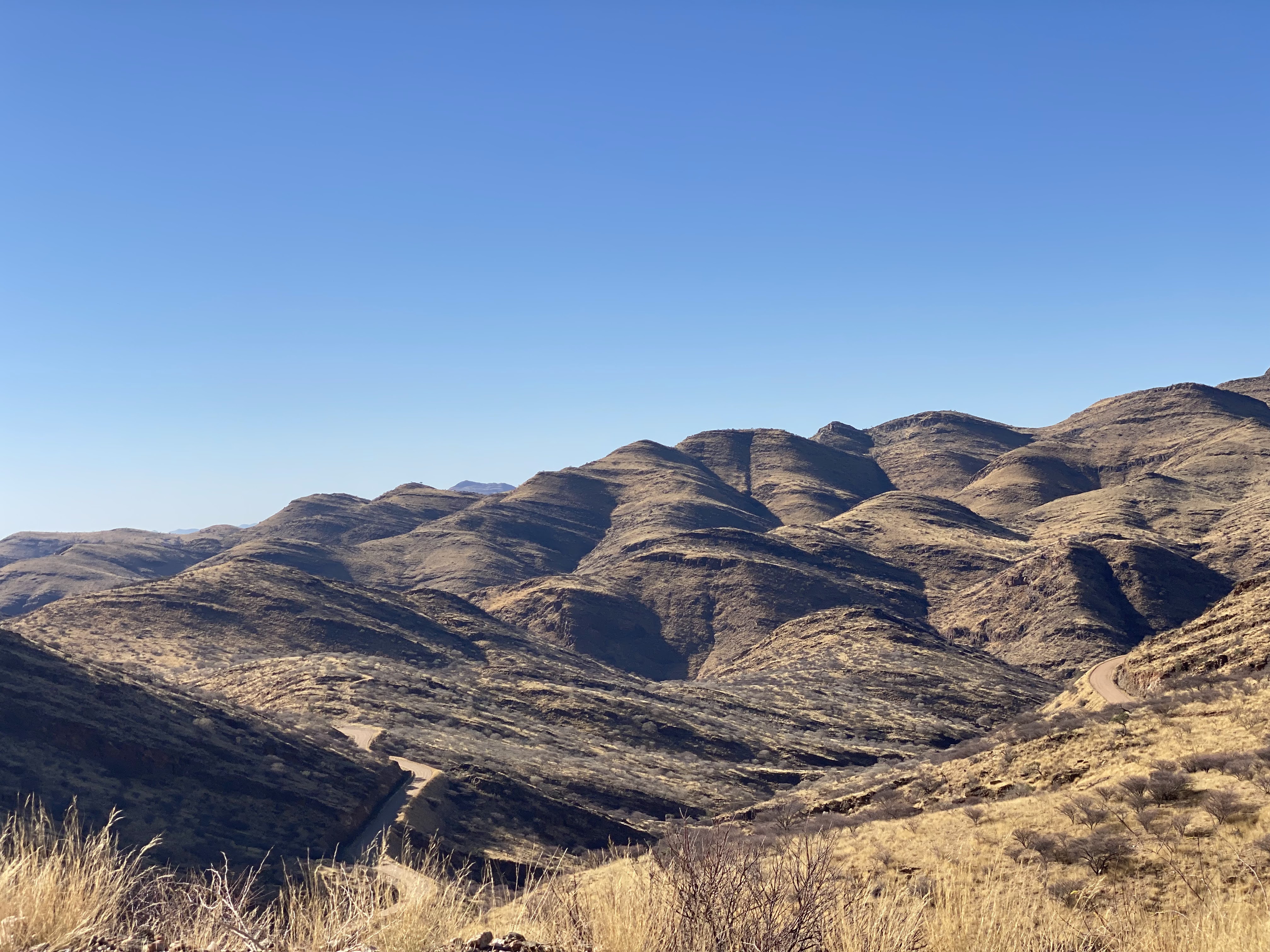
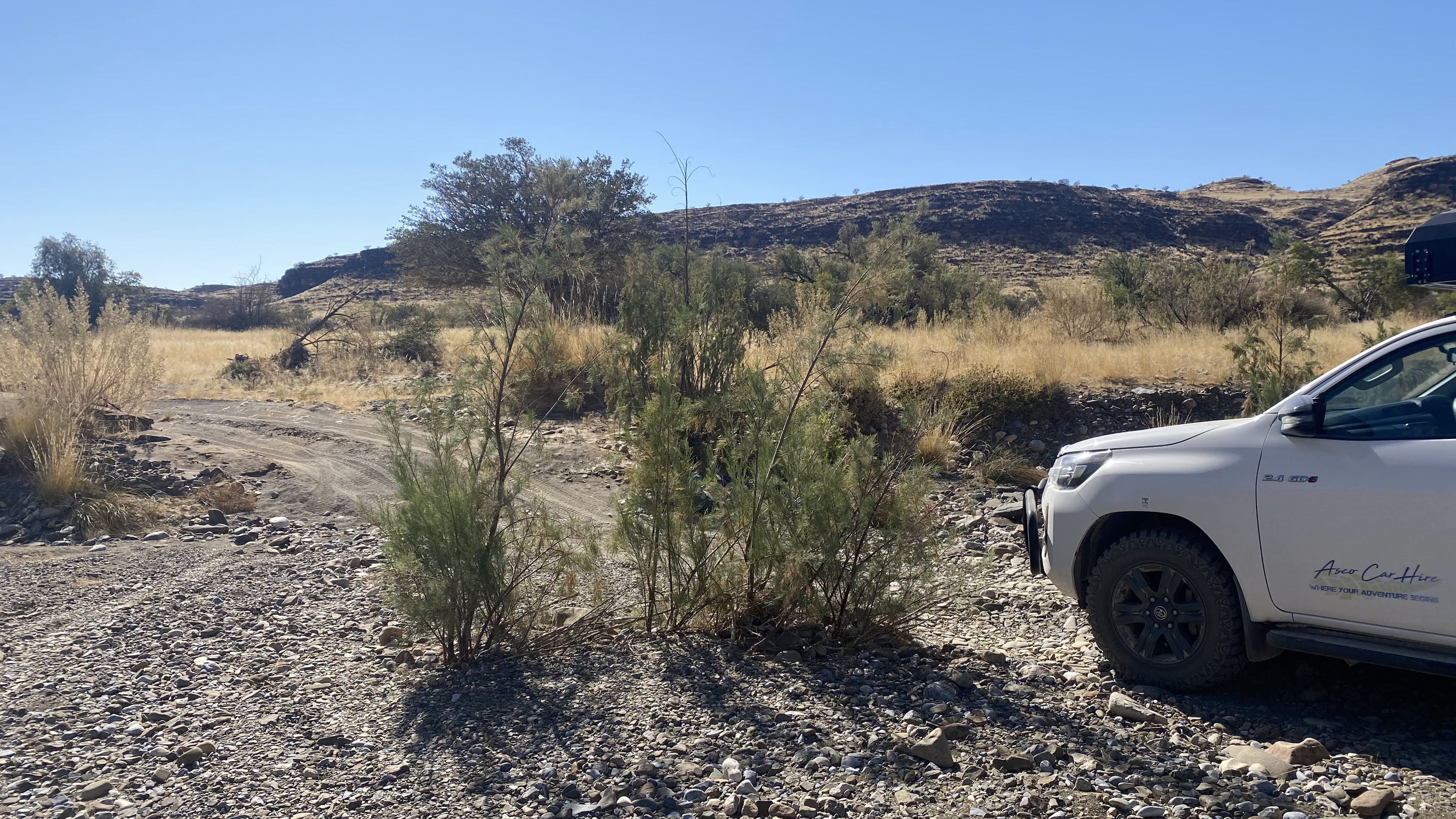
Oh, and there’s no way to estimate the quality of a gravel road in advance, since it’s entirely down to how recently the road scraper has visited and whether it rained anywhere in the region since then. You might guess that a C road gets scraped a bit more often than a D road, and it probably does, but there are many kilometers of road and not very many scrapers, so it’s largely down to luck. The only exceptions are B roads, which are usually paved but don’t go to the interesting places, and F roads, which have never heard of a scraper and are likely to consist mostly of oryx trails and usually-dry riverbeds.
Safety, comfort, and avoiding flat tires: there’s one MORE reason you need to drive slowly in Namibia. Your rental car comes with a black box and it knows if you exceed the rental company’s permitted speed, which is 80kph on gravel roads and less in city limits: regardless of posted speed limits or your own personal feelings. If you exceed that speed limit, your insurance is void. Do not make this mistake; there are plenty of negative reviews online from renters bemoaning the fact that they had to pay for a scratch or a tire or a whole car because they drove too fast. Don’t be like them. Drive slow.
2) Don’t just haul that pressure gauge and compressor around, use it.
Your Asco rental comes with both, and for good reason. The pressure gauge has a little nub on the side, and you’ll use that to let the air out of your tires before you venture onto the gravel roads, and then let some more air out before you venture onto a sandy stretch. You’ll only use the compressor at the end of the trip when you revisit a highway, or possibly to touch up the pressure if you had to drop it especially low for sand.
You’ll want to run your tires at about 1.8 bar once you leave the highway, and drop down to 1.5 or even lower if you encounter real sand. Remember that the pressure in the tire rises once they heat up from driving, so setting them to 1.8 cold will still work out to around 2 bar once they heat up. If you, like me, never heard of a bar that didn’t involve drinking or weightlifting, this is just the number you’ll look for on the pressure gauge. Basically you want the tires a little on the squishy side, for a few reasons:
- It makes for a more comfortable drive: they’ll stick to the gravel surface better and you won’t jitter and slide around as much on the washboard sections of road
- A squishy tire is much better able to withstand a sharp rock. Think of it like a balloon: if you blow up a balloon all the way it’ll pop if a needle winks at it, whereas if you only blow it up halfway or so, you really have to stab it with purpose to make it pop. You want your tires to act like the latter.
Side note: don’t park under acacia trees. The local name for them is “camel thorn” and those thorns can go right through a tire, let alone your shoe.

3) Don’t underestimate the sand.
Most of the roads are gravel, but you like dunes, right? Namibia is full of beautiful dunes. The thing about dunes, though, is that they’re made out of sand with a healthy dose of wind, and the thing about wind when combined with sand is that it tends to put the sand wherever it likes. That includes across stretches of road, all of a sudden, sometimes without warning.
If you see a sandy patch in time to stop (safely) before you hit it, do so, and give it a look on foot before you put your vehicle in there. That will help you understand how deep and slippery the sand is, and make appropriate arrangements to deflate your tires or at least plan your approach.
You’ll want to make plenty of photo stops and you should always pull over safely, but be wary of the roadside; a perfectly rocky gravel road often has a foot or two of sand on the shoulder, left by road scrapers over the years. Look for tire tracks before you pull over, as those can give you a pretty good idea of what you’re in for, and whether you’re likely to get out.
When you do have to drive through a sandy patch, it’s a lot like driving in deep slush for my fellow northerners. Go slow but most importantly, keep the speed steady; momentum is your friend. Steer with the slide, don’t fight it. And whatever you do, don’t stop if you can safely avoid it. Oh, and if a local tells you that you shouldn’t drive to a certain place (like into Sossusvlei), listen to them.
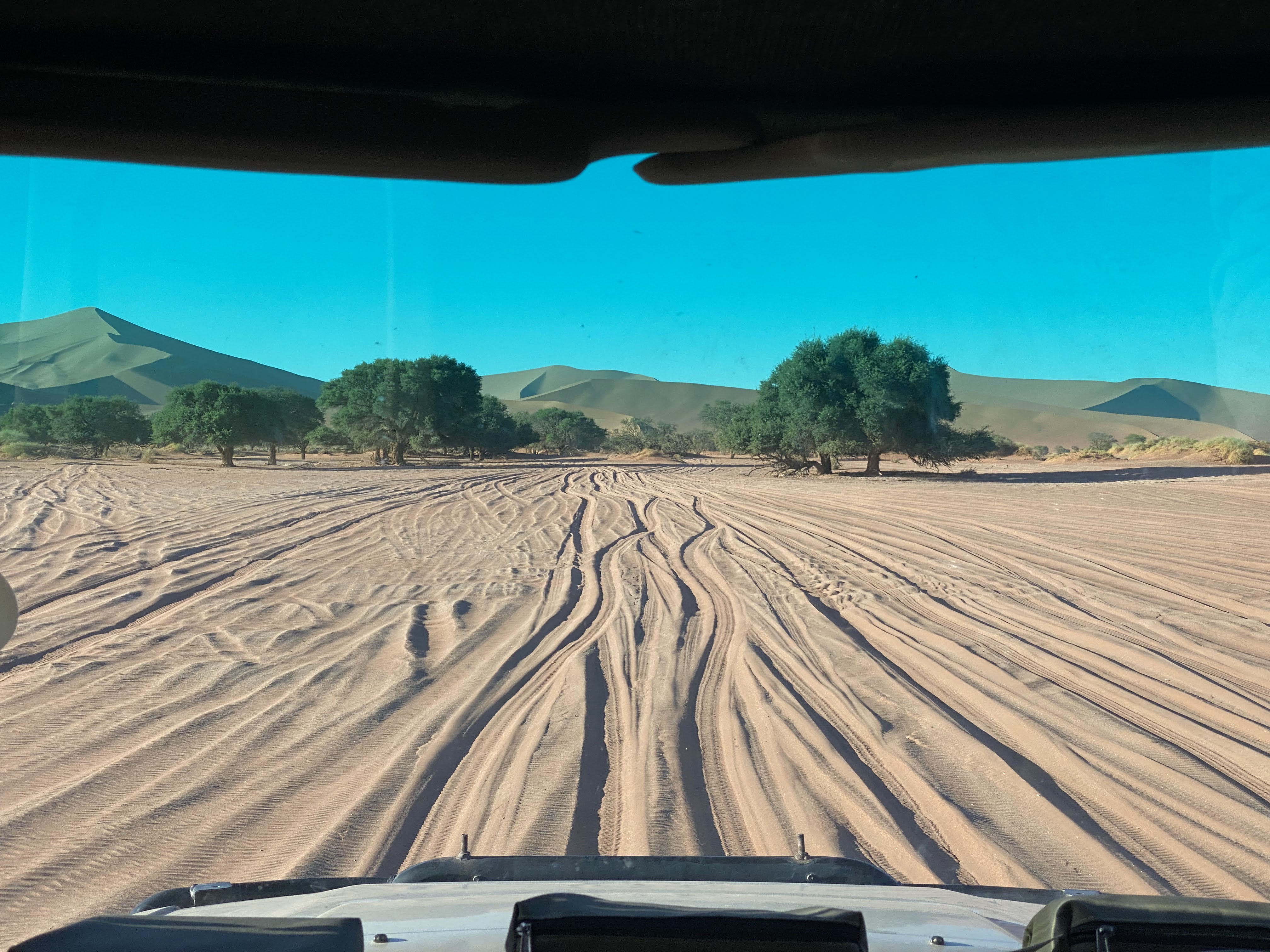
If you do get stuck in the sand, don’t panic: this is why you watched those tutorial videos in advance, which have lots of helpful tips regarding how to get unstuck. You did watch them in advance, right? I hope so, because there’s almost certainly no cell reception where you found the sandy patch. I’ve thankfully never gotten stuck (which should be your goal), so I’m not much help on this front, I’ve only got the book learning.
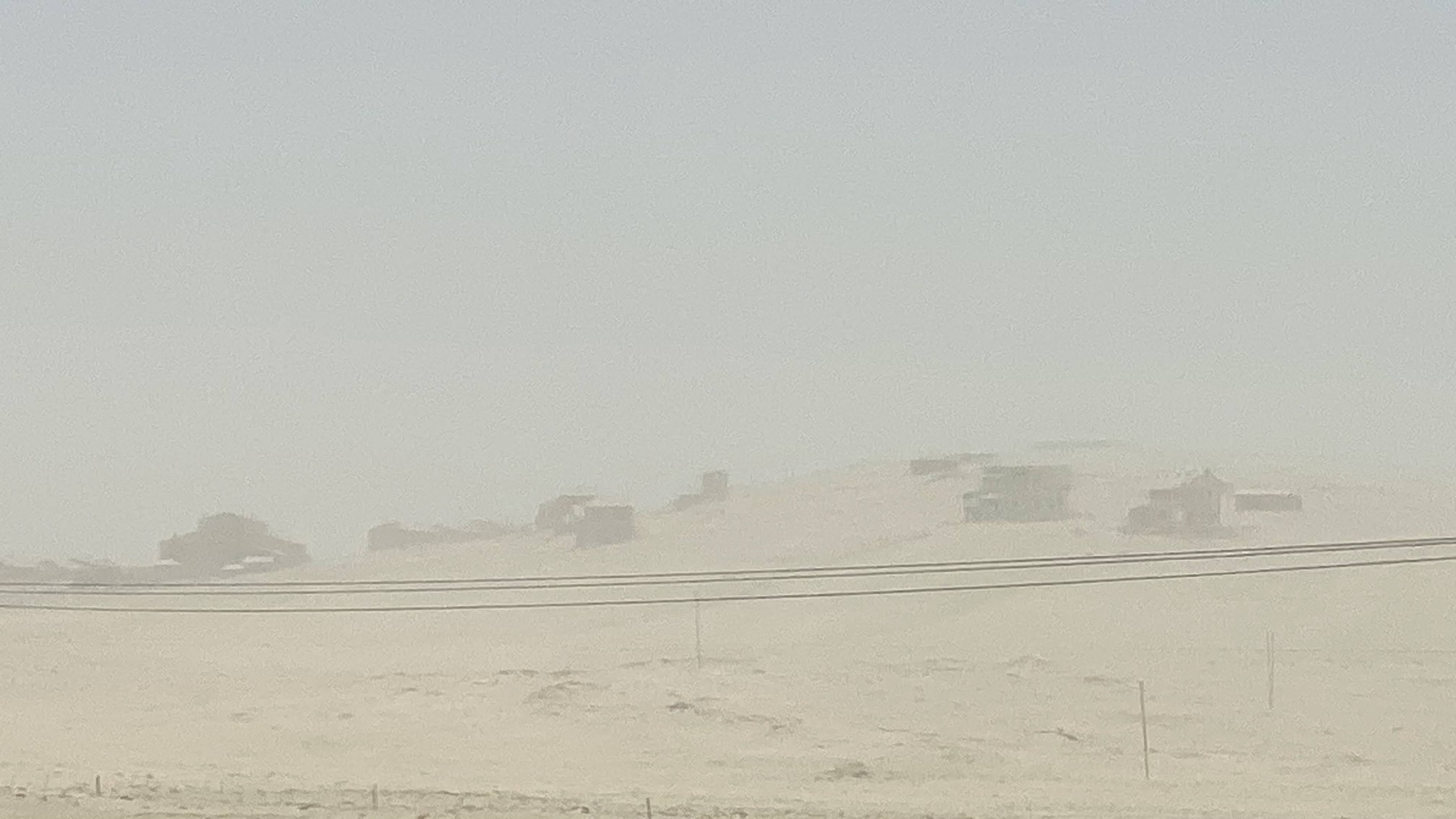
Sand on the road is one thing, but if the sand starts blowing, you stop driving. Pull over (safely) and batten down the hatches to ride out a sandstorm.
4) Open the dust hatch.
Your vehicle has a little hatch that pops up at the top of the back canopy. This has to be open any time you’re driving on dirt roads, otherwise the pressure differential will literally suck all the dust into the back of the truck, making life difficult for your fridge and very unpleasant for anything else back there. It’s not the kind of sand you can just shake off, either; it’s dust, and it sticks.
The only reason to close this hatch is if it rains (or if you’re in a sandstorm, but at that point it’s too late and you should stay inside the car). If you close it, set yourself a reminder to open it before you drive.
Oh, and speaking of dust: somewhere in your supply kit is a little broom and dustpan. Do yourself a favor and find it before you start driving, then use it to dust off the back of the truck before you open it up, else you’ll find yourself completely covered in a fine brownish powder.
5) Drive with your headlights on, always.
Having your headlights on while driving is important for safety, and is mandatory in Namibia at all times of day. Police watch for this and will issue a steep fine if you forget.
Safety
In addition to driving safety, you’ll want to consider a few other things on your trip. Namibia is a very safe country, but it’s also very remote and very poor, so some precautions are necessary.
- Keep your valuables out of sight. Don’t create temptation for people who have very little by showing off how much you have. Don’t wear flashy jewelry, don’t wave your phone around or leave it sitting on a table, don’t park your car with anything visible through the windows, and separate cash into small portions so you don’t show a huge wad of bills when you open your wallet to pay.
- Be wary of people along the road. We were warned in several cases not to stop if, for example, someone points at something on your car and yells at you to stop. As our Asco agent explained, “Your car will tell you if something is wrong, and if you are in doubt, drive along the road until you are out of sight, then stop and check.” You will see people begging along the road near settlements, and although it’s always good to help those less fortunate, it is unfortunately not always safe. If you want to give something like water or food, consider putting it in a colorful bag and dropping it on the roadside a bit further along, so that the person can see it and fetch it once you’ve left, then drive on.
- Watch out for creepy crawlies. While most of the country lacks large predators, Namibia has several common and deadly snake species, plus dangerous scorpions, centipedes, and spiders. Modern medical care is not available outside the city, and small towns won’t even have a clinic. In other words, if you get bitten by a snake, there’s a very good chance you will die. Keep your tent closed up tight, swing your flashlight wide when you venture out at night, and steer clear of underbrush and rocky crevices.
- Know what’s in your first aid kit. Hopefully you won’t have to use it, but if you do, that’s not the ideal time to open it for the first time. Even if you don’t need it for yourself, you might use it to help someone else along the road.
Supplies
As stated above, I’m not really a “camper” so take my advice with a grain of salt. Here are a few things I found useful that you might put on your shopping list. Speaking of lists, definitely make one and check things off. Do your shopping in Windhoek (Superspar has most of what you’ll need, and it’s next to the mall for any other last-minute items). Don’t plan on picking up anything you forgot along the way; you can drive for days in Namibia without seeing a shop, and the shops you do find will have a limited selection.
There are plenty of camping supply lists on the internet; Asco even has a video about it. Your rental comes with all the basic equipment (pots, pans, cutlery, camp chairs, gas canisters with burner tops…) but you’ll need to buy everything else.
- Fire & safety: wood, firestarters, a lighter (very important unless you plan on prospecting for flint), flashlights, and a safety blanket (they’re good for keeping the sun off as well as keeping you warm if something goes wrong).
- Bugs & sun: insect repellant, sunscreen, a hat, good desert clothing (this long-sleeved airy UV shirt was a lifesaver, consider something similar), an ice towel, sandals for trips to the toilet at night.
- Kitchen items: tinfoil, a variety pack of ziplock bags, garbage bags, a dish towel, dish soap, sponge, paper towels.
- Toiletries: all the things you’d normally travel with (soap, toothpaste, etc.) plus toilet paper. Don’t forget the toilet paper.
- Food & drink: bring lots of water (always crucial in the desert, bring more than you need), plus whatever else you like to drink. For food, three main categories:
- Shelf-stable things like canned foods, peanut butter, bread, long-life milk (get small containers so you can open and refrigerate one at a time), coffee, whatever else you consider essential.
- Things that require some refrigeration, like cheese, mayo, jam, oranges. You’ll have a camp fridge, but you’ll want to raise the temp to about 10c for multi-day stays so its dedicated battery lasts, and only run it on true “cold” on driving days. Think of it more like a battery-powered cooler box than a home fridge.
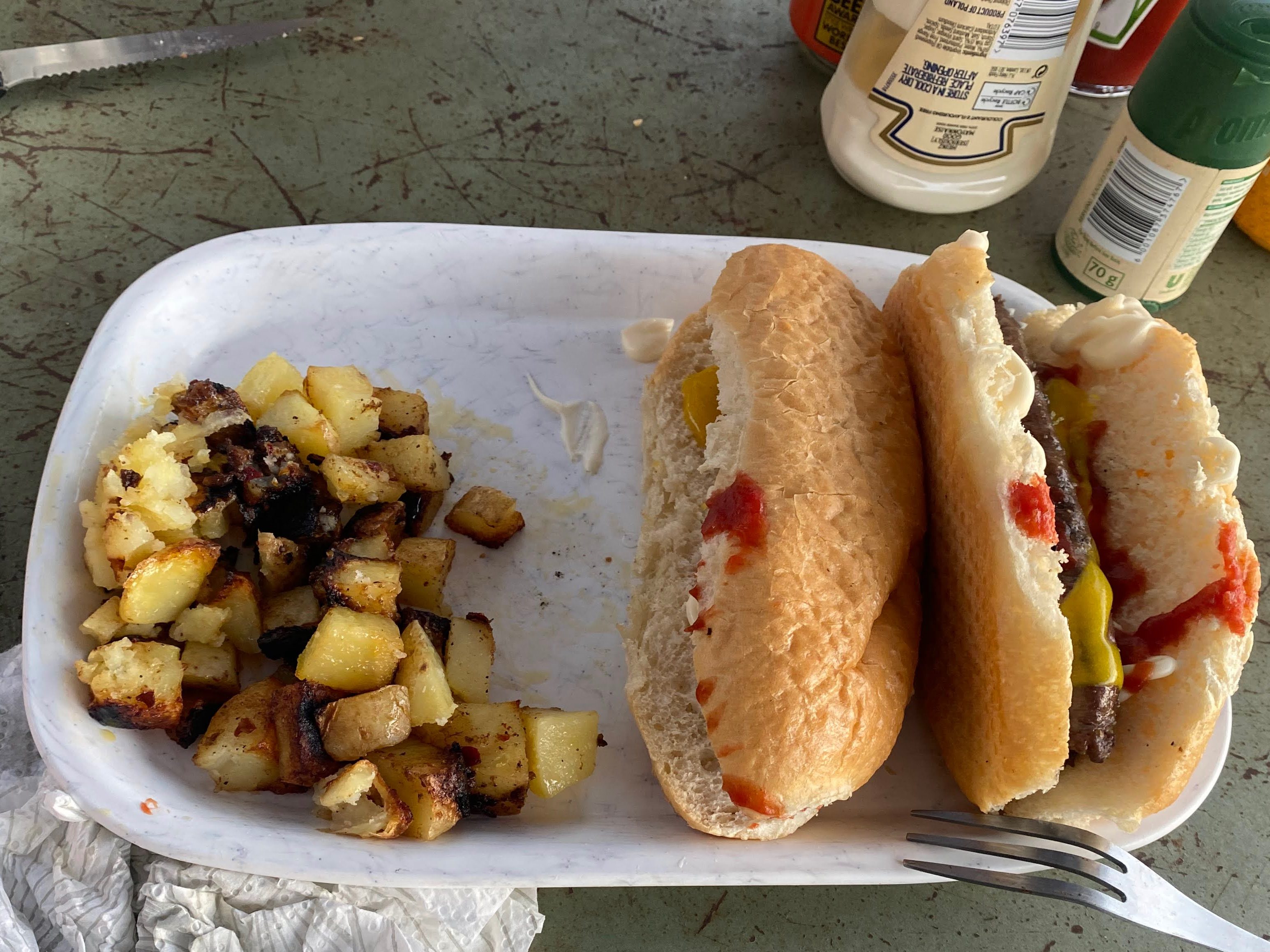
- Snacks: biltong, chips, nuts, hard candy, whatever you like. Avoid chocolate unless you like it in puddle form.
Supply-related tips
Those are the basics, but here are a few more things we learned along the way:
- Buy a pack of large heavy-duty garbage or garden waste bags and double-bag everything that doesn’t belong in a desert before putting it in the back of your vehicle (the cargo part). For example, we bagged up our tech bags and our main luggage after taking out the things we needed for the camping trip. You don’t want to park in populated areas with anything visible in the back seat, but anything that travels in the back of your truck will get very dusty (even with the hatch open as noted above).
- Use padding (or space) between items, especially liquids. Long drives on gravel roads means a lot of vibration, and on both trips we had liquid spills due to friction burns. On the first trip, two bottles of water rubbed against each other and developed holes, causing a small flood in the back. On the second trip, a can of beer encountered a bottle cap and popped itself all over the fridge. On both trips, our luggage (despite being in plastic bags) developed raw patches from rubbing against other items. Learn from our mistakes.
- Keep your sandals with you in the tent (bring a plastic bag to put them in to reduce sand in your bedding). There are foxes and jackals in the desert and we learned from a guide that they like shoes as much as any other canine.
Where to go
As with any trip, it depends on what you want to see. I like the desert, so I’ve only spent time in central and southern Namibia, but there’s a lot to see in this country, including a completely different non-desert region in the north. At a high level:
- A mountain range cuts the country in approximately half from north to south. The east side of the mountains is pretty boring. The west side, broadly speaking, is the desert, and is gorgeous.
- There are multiple passes through that mountain range, which are beautiful and terrifying in varying degrees, most with a lookout near the top. For example:
- Spreetshoogte is short, steep, and sort of paved (only on the pass itself). The turns are tight and the edges are sheer.
- Gamsberg is longer, gravel, and through more of a badlands landscape. It’s not as scary though there are some blind curves and sheer drops and narrow parts.
- Gaub pass runs north/south on the desert side. It goes through badlands and has a dry riverbed at the bottom that’s crystals for days.
- If you like history, Kolmanskop is fascinating.
- The Fish River Canyon is the second-largest canyon in the world, after the Grand Canyon.
- Sossusvlei is where the tourists go; it’s an incredible landscape but it’s crowded and the impact is starting to show.
- The Skeleton Coast is interesting, windswept and relatively desolate with lots of shipwrecks and salt mines. If you go that way you’ll get to drive on the salt roads; basically compacted salt that’s pretty similar to pavement (slippery when wet, I understand?) and a pleasure after all the gravel.
- If you like large animals and don’t mind malaria pills, you can go north to the wet part of the country, where you’ll find big game reserves like Etosha. I haven’t been (I don’t like mosquitoes). You don’t have to go north to find amazing animals; in the desert you’ll find oryx, zebra, giraffes, gemsbok, kudu, springbok, klipspringer, jackals, wild horses, wildebeasts, warthogs, and more.
Recommended Campsites
Again I refer you to the #notacamper disclaimer at the top—there are a wide range of camping opportunities in Namibia, so do your own research and choose the kinds of campsites you prefer. I personally like a campsite that’s a) as remote as possible but also b) has a shower and a toilet, so if that’s your jam, here are some of my top recommendations! I recommend spending at least two nights per campsite, ideally three, otherwise you’ll be driving all the time and won’t be able to actually relax and enjoy your surroundings.
Namibgrens
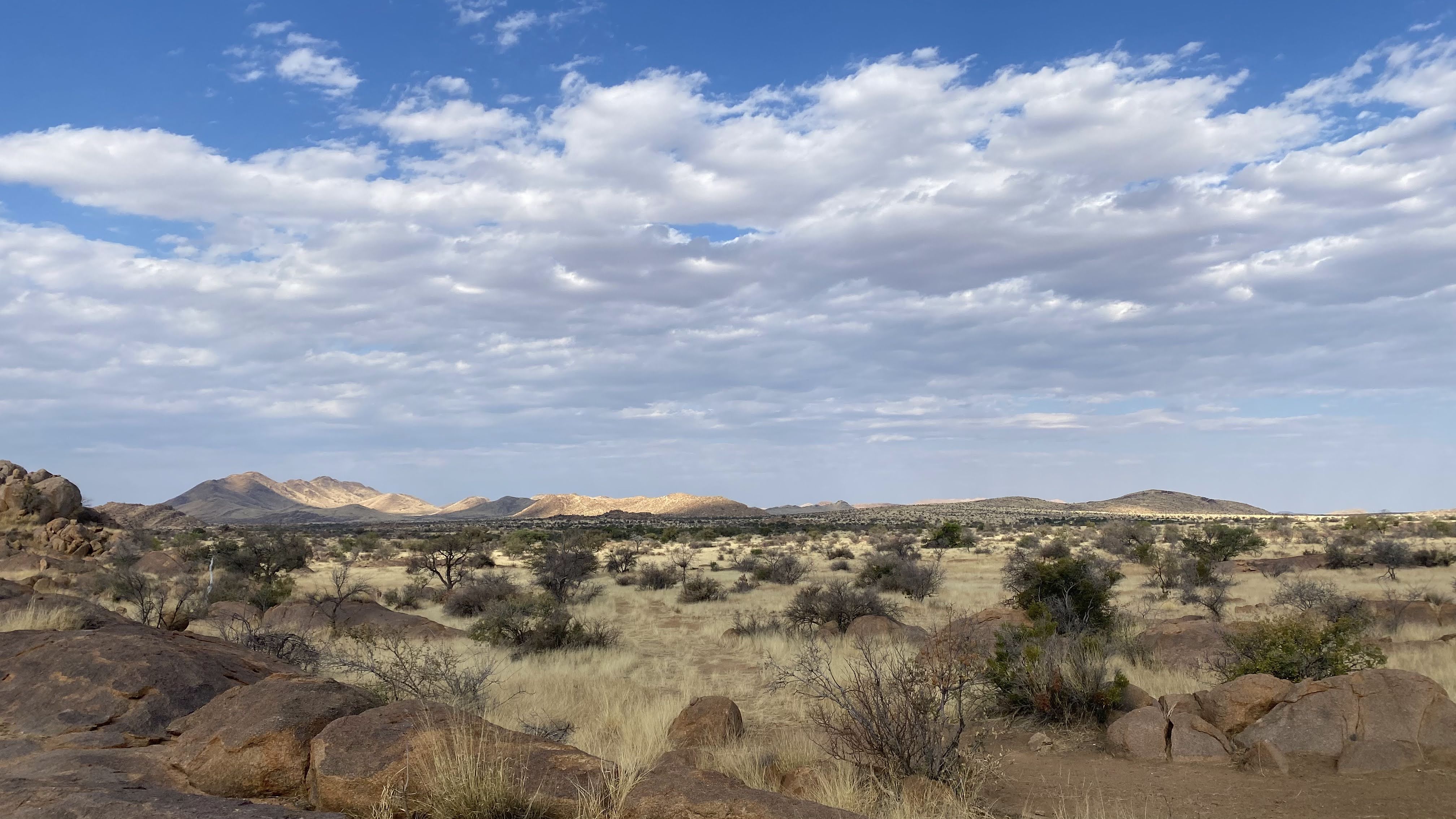
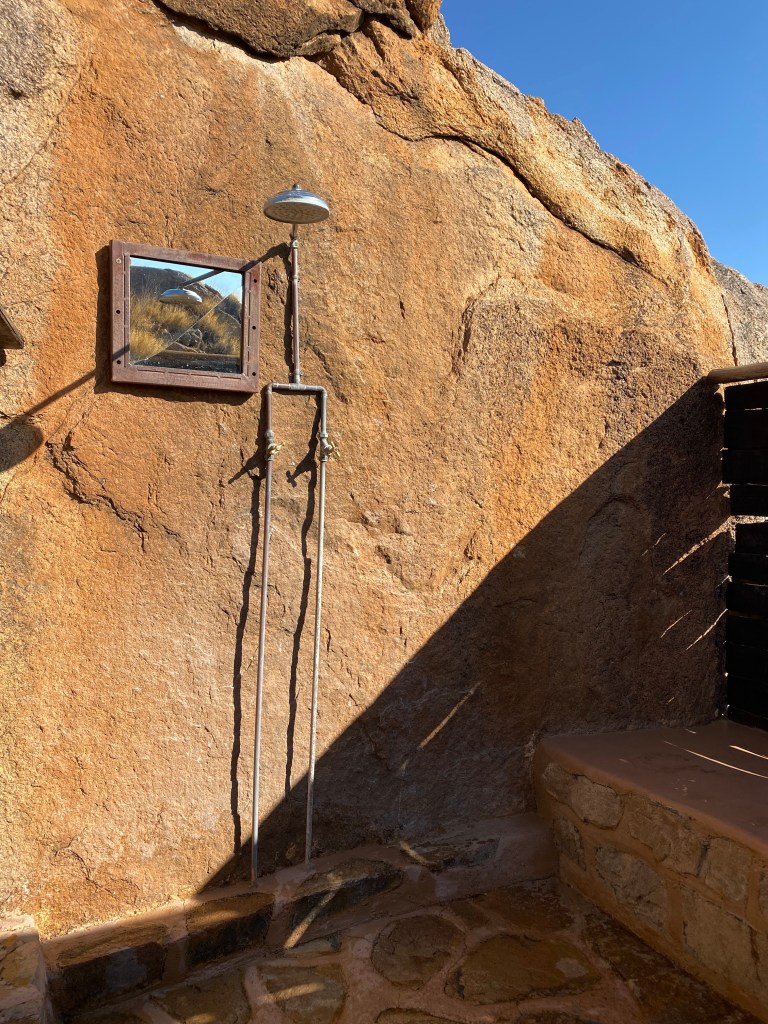
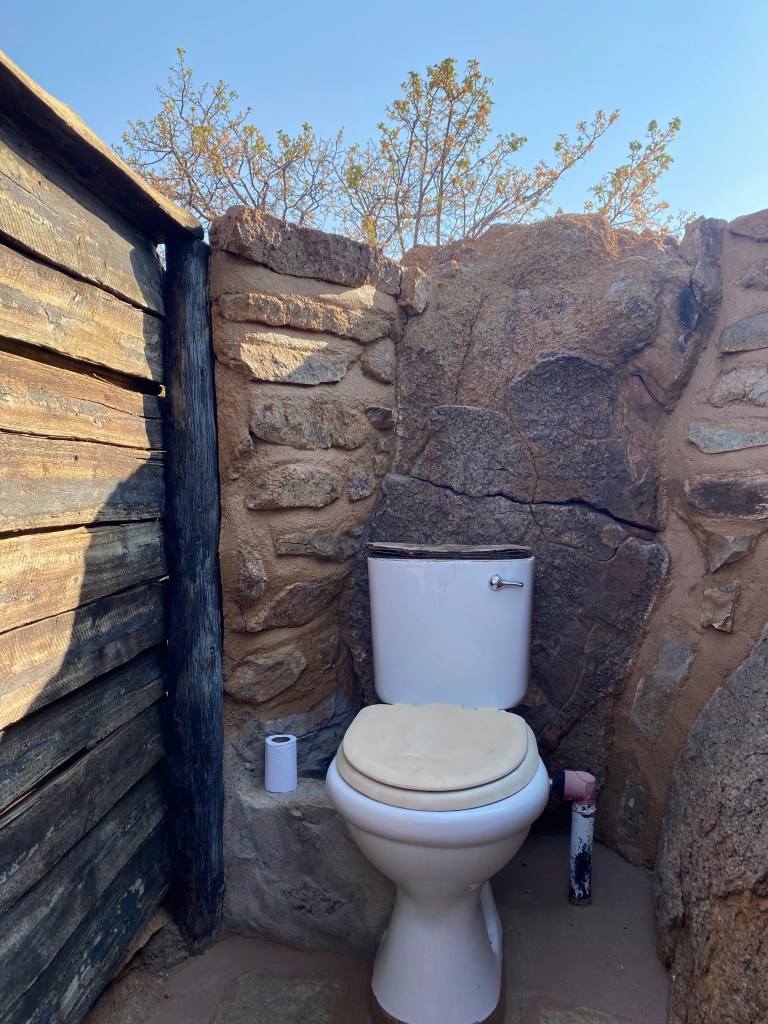
Namibgrens Guest Farm has a set of 12 well-spaced campsites in a mountain valley about 3 hours out of Windhoek. It’s a lovely spot, safe and beautiful, with good shade, hot water, and flush toilets, but no electricity. The water is heated by a donkey (translation: a wood-fired hot water tank) which the farm staff lights in the afternoon; it stays hot through the following morning. We stayed in Campsite #1 and would highly recommend it.
You can pre-order a braai pack which was delicious, and in our case included homemade bread, salad, sausage, and wildebeast steak (contents vary based on what’s fresh). You can also arrange to have fresh cooked breakfast at the farmstead, which is a great way to start your journey when you leave for your next spot (it’s a bit far from the campsites so I’d only suggest it when you’re driving out).
Speaking of food, note that there are a couple large troupes of baboons in the area. They’ll likely avoid you, but keep your food locked away so as not to attract them.
Camp Gecko
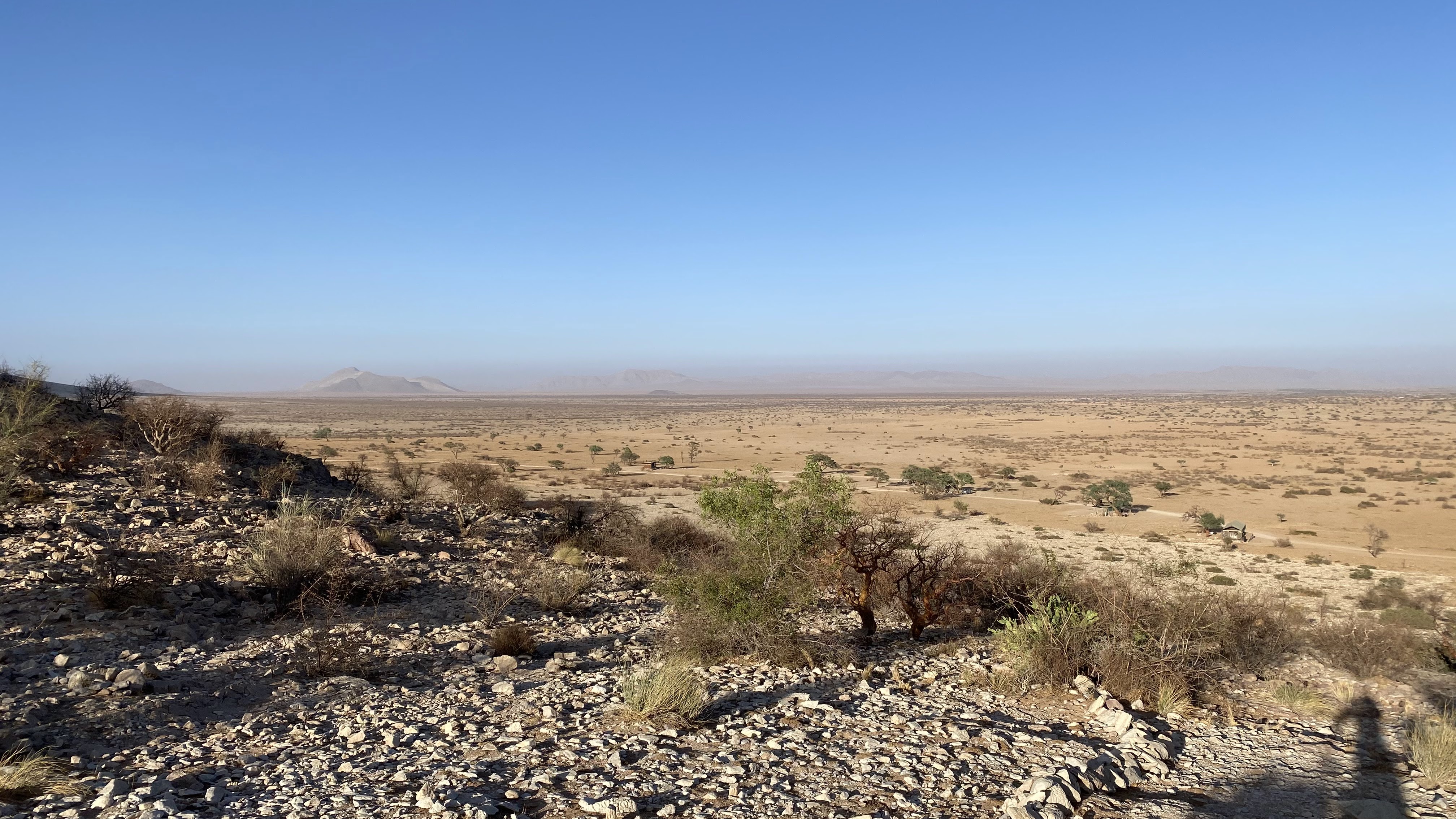
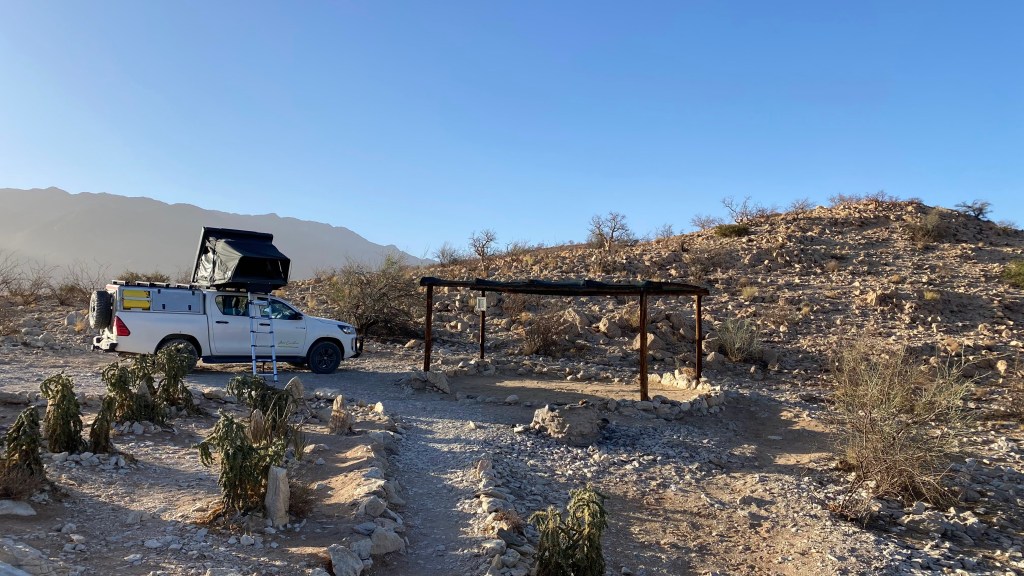
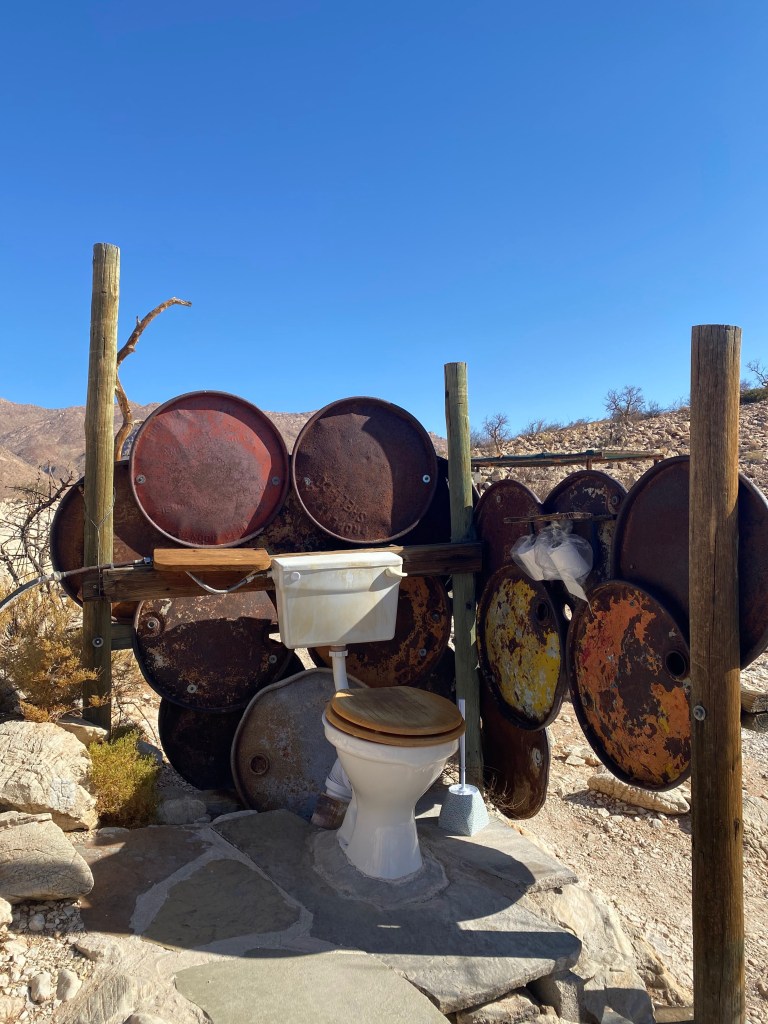
There are three mountain campsites at Camp Gecko, all separated from each other with beautiful views, showers, toilets, and shade, but no electricity. The water is heated by a donkey which you light yourself (without lighting it, it’ll still be lukewarm in summer since the tank sits in the sun).
Like at Namibgrens, you can arrange a braai pack (which was also delicious and included warthog sausage and kudu steak on our visit). You can also arrange to have breakfast in the Lapa which is walking distance from the campsites, and was cooked to order. Camp Gecko is just on the other side of the pass from Namibgrens so I would pick one or the other, rather than both back to back.
NamibRand Family Hideout
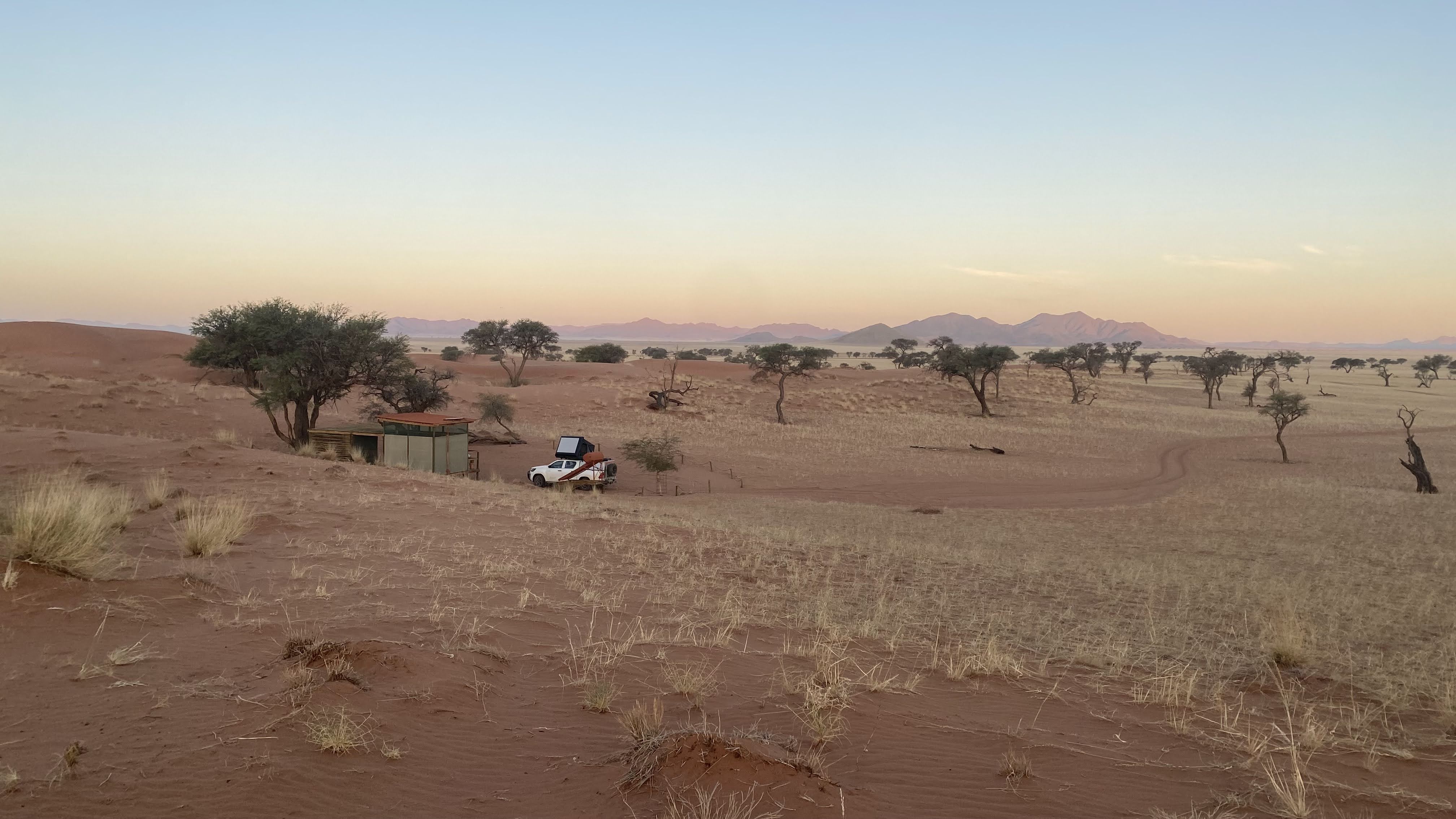
There are only three campsites at NamibRand Family Hideout, each in their own secluded dune valley. This is the most remote-feeling place we stayed, and it’s quite magical! There’s solar-heated water (nice and hot) and solar lights and a flush toilet, with the shower and toilet in a screened enclosure which keeps the flies out.
This is important, as the only negative aspect of these sites is the flies, which are numerous and very tenacious (though not of the biting variety, just the annoying buzz-in-your-face type), to the point where we sought refuge in the bathroom one afternoon. Each campsite also has a watering hole, so you’re very likely to see oryx, springbok, and possibly giraffes right from your tent, as well as lots of pretty birds.
There’s no food available here or anywhere for many miles around, so plan ahead. You can arrange a nature walk with a guide (which we did, it was super interesting), as well as things like a dune drive.
Farm Tiras
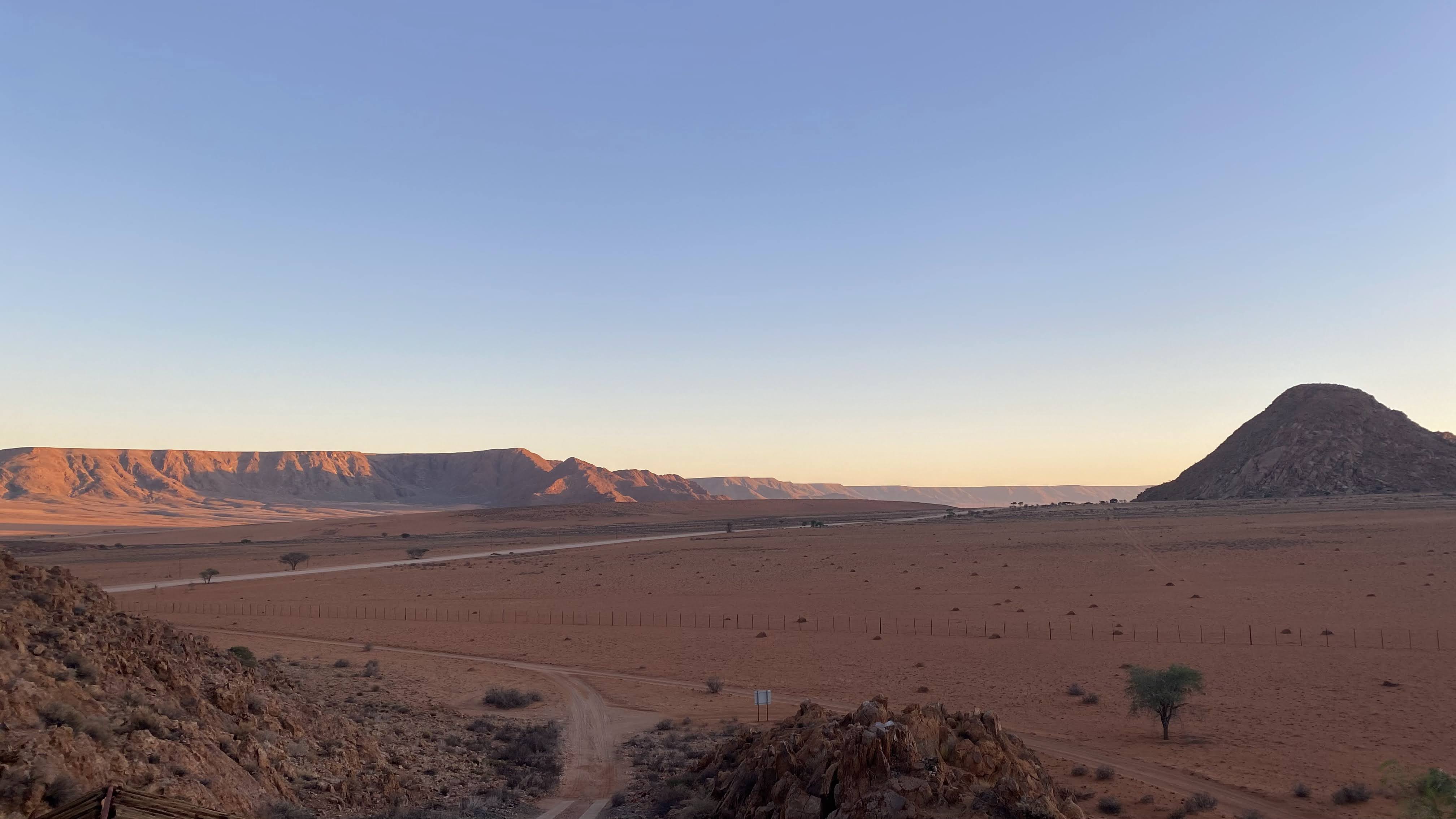
Mountain Campsites B and C at Farm Tiras are beautiful; we stayed at B on the hill, and C is down below. You check in at the farmhouse, then drive out to the campsite, which has hot water, flush toilets, and a shade area with firepit. The view is beautiful.
This farm and nature reserve is quite far south, so may not make sense if you’re doing a loop from Windhoek. If you’re driving up from South Africa, it’s a great stopping point along a relatively main road.
Landsberg Farm
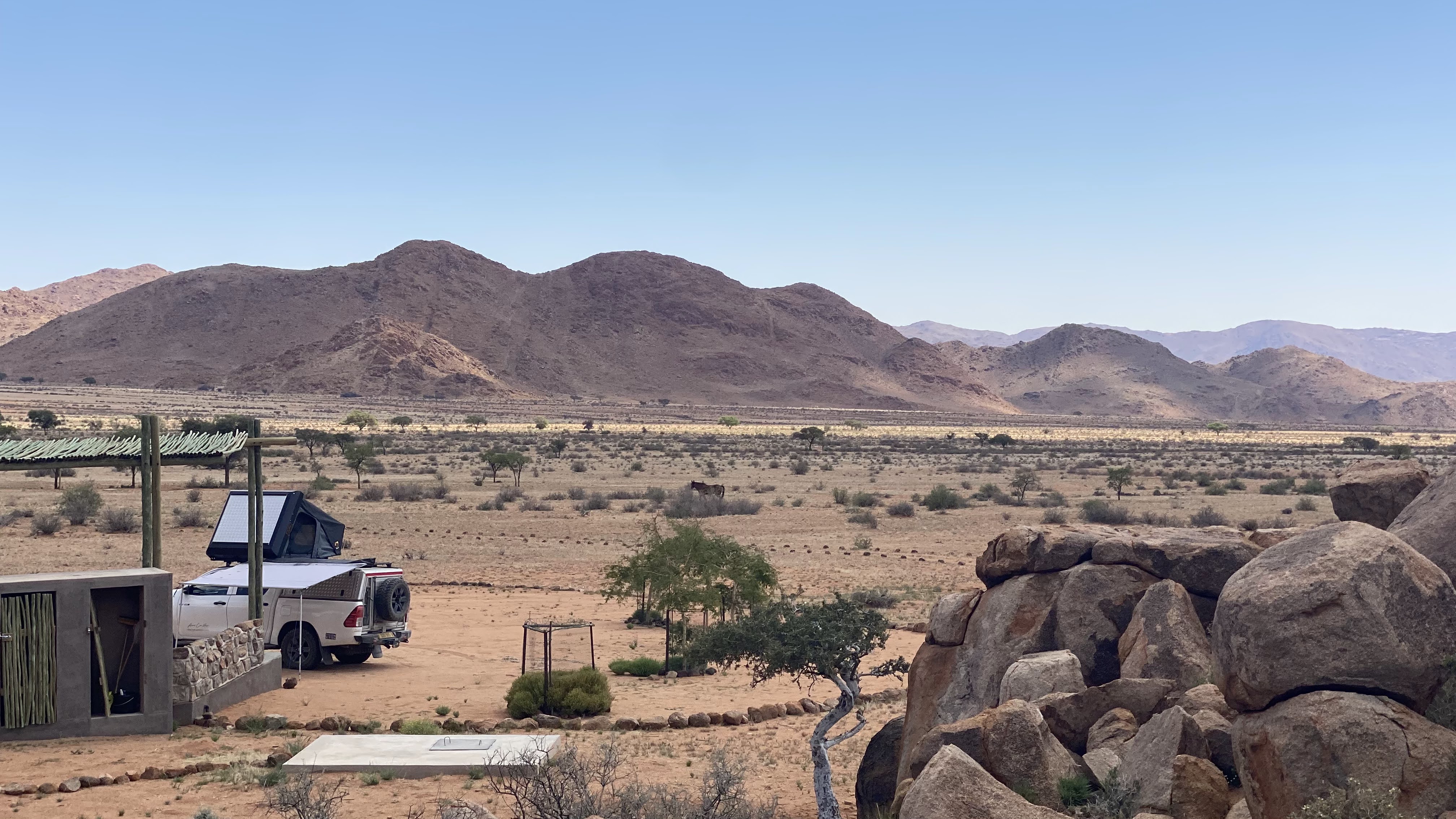
Landsberg is on the same nature reserve as Tiras, but on the backside of the mountain. The campsites are excellent, very clean, well separated from each other and the farmhouse, and have nice views of the valley. They have on-demand hot water from a gas boiler, toilets, and partial shade.
Their website mentions that you can prearrange food packs, but contact them in advance; on our visit the farm owner was away so this wasn’t possible.
This is a beautiful site and truly remote; it requires a 25-kilometer drive on a farm road which definitely needs 4×4. If you choose to stay here, allow plenty of time; those 25 kilometers took us a full hour to drive each way.
Recommended non-campsites
Camping is the main thing, but there are a couple exceptions worth mentioning.
Hakos Astro Farm

Hakos makes a great stop for the end of your trip, as it’s only about 2.5 hours from Windhoek (allow 3 for safety). It’s a unique place; a German guest farm in the high mountains in a dark sky reserve, packed to the gills with fancy telescopes and astronomers.
The rooms are comfortable and clean, the hosts are lovely, and the dinner is fantastic and served family-style so you’re bound to have some interesting conversations about space. You can also book a stargazing talk, which is interesting though quite basic; it’s good for novices and you do get to look through a very fancy telescope and ask questions.
There are also a few campsites, but we didn’t stay in those because we wanted to repack our luggage and sleep in a bed and head out early for our flight without having to break camp. If you move around after dark you must use red light flashlights so as not to disrupt the space photography.
Kulala Desert Lodge

If you want to feel very fancy, sleep in a real bed or a made-up mattress on the roof and look at the stars, have a private driver bring you out to Sossusvlei through a secret gate ahead of the crowds that line up at the main entrance, enjoy a very nice meal and a pool, and pay an eyewatering price for the privilege, Kulala Desert Lodge is a very good choice. It’s really expensive, but all the points above take the sting out, and of all the options near Sossusvlei, I think it’s probably the best, and you only need to stay one night if you arrange the morning tour and have them hold your luggage or allow a late checkout.

One obnoxious thing about this lodge (though not unique to it) is that you can’t book with them directly. Instead you must book through one of several travel agents, which requires email correspondence. The travel agents are accustomed to booking entire vacations for wealthy Europeans, so it’s difficult to explain that you don’t need a private plane from Windhoek airport or any of the other things they suggest, but will rather be driving up on your own at the allotted time, and paying only for the lodge. Good luck.
Bahnhof Hotel Aus

The Bahnhof Hotel Aus deserves mention, though if you’re looking to stay in the area, chances are you’ve already found it since it’s the only proper hotel for miles around. Nonetheless, it is clean and comfortable with pretty good food and nice people, and it’s a good choice if you’d like to sleep in a bed and visit Kolmanskop (well worth a trip).
Parting notes
Namibia is an incredibly beautiful country, full of stunning landscapes, fascinating animals, and kind people. It’s easy to get around as long as you have a 4×4 vehicle and plenty of time, and it’s one of my favorite places.
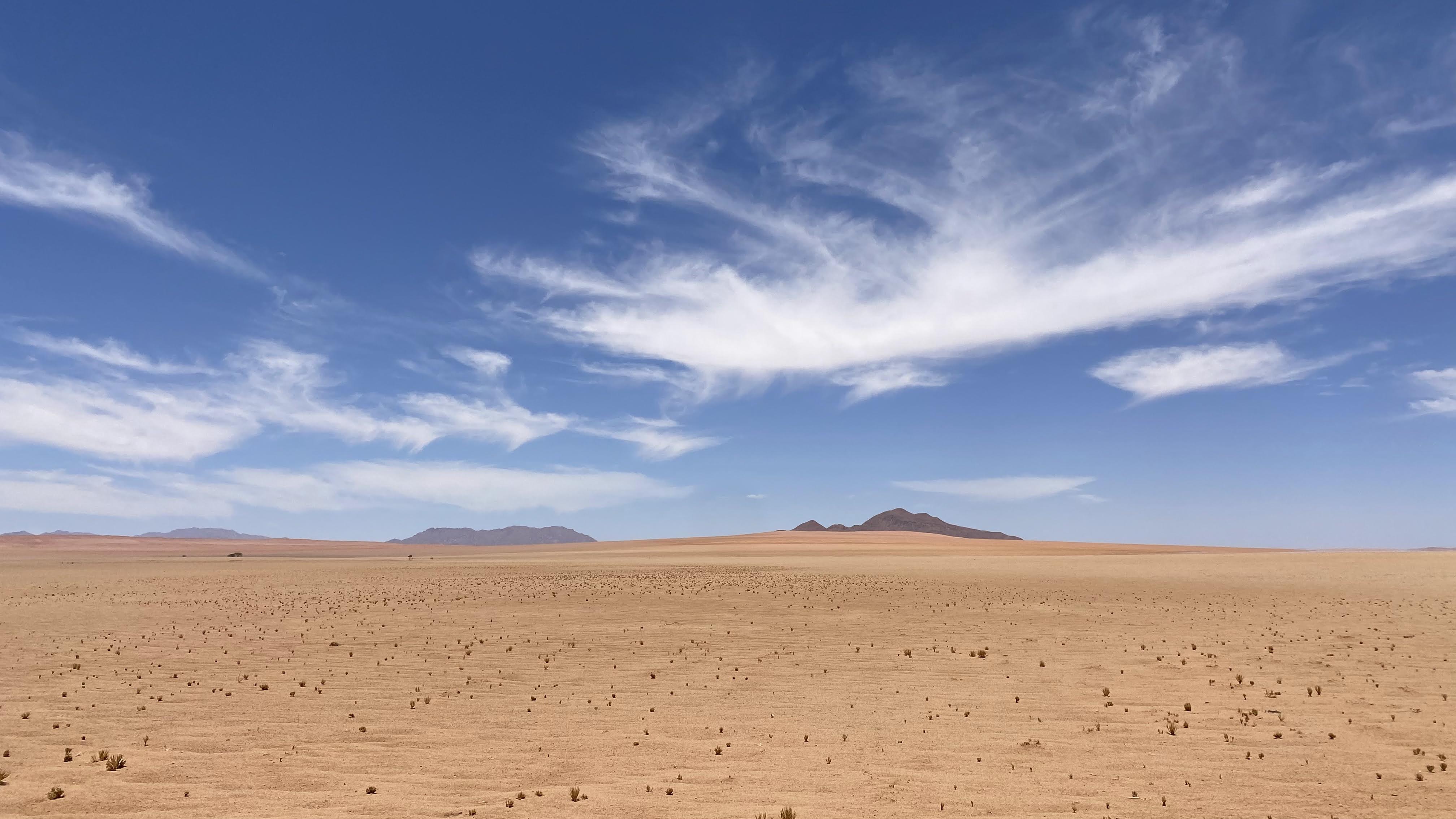
It’s important to me to acknowledge that there are reasons why it’s the second-least populated country on earth. It’s not empty because it’s impossible for humans to live in this landscape; it’s empty because the people that used to live here, don’t anymore.
Do your research to understand how it came to be this way. Learn about the Herero and Nama genocide, about the history of concentration camps, about the diamond rush and the diamond industry that’s still in place today, and about apartheid. We can’t change the past, but we have a responsibility to understand what happened, and why, and consider how such atrocities can be prevented moving forward.
And while you’re here, be respectful: to the people and to the nature. Pack it in, pack it out, leave no trace, and tip generously. Your money goes a long way here.

 Shastified, Continued